For this Play Journal, I played Limbo, an unapologetically morbid yet entertaining platformer. This game has simple rules but the creativity of the mechanics generates puzzles demanding the player’s reflexes and intellect.

According to Fullerton, rules do three things: “define objects and concepts” (Fullerton 77), “restrict actions” (79), and “determine effects” (79). Limbo plays heavily into rules not having to be “something that players must directly manage” but rather “gain an intuitive knowledge” (78). The only explicit rules are the player’s following:
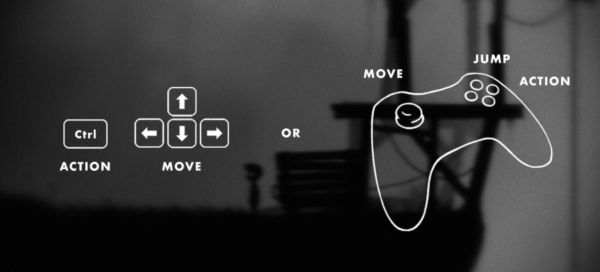
Besides that, the player has to discover the game-defined objects and concepts. It basically goes like this. The game puts something random in front of you and says, “Figure it out.” The tasks are simple enough that it’s not an impeding learning curve. You quickly discover what’s possible, such as moving boxes and climbing rope. Moving to the game’s restrictions, it’s basic things like being bound by gravity, unable to swim, and being a one-hit kill. The first two parts of Fullerton’s definition are straightforward in Limbo, but the game’s heart lives in how it “[determines] effects” (79).
Since this is such a major part of the game, I want to now integrate the concept of mechanics. Sicart defines mechanics as “methods invoked by agents, designed for interaction with the game state” (Sicart). Since you are only given five keys, the whole game revolves around triggering effects and invoking methods. And the effects are often unexpected. This can all be summed up by Sicart’s term of “contextual mechanics,” that is, “mechanics that are triggered depending on the context” (Sicart). I remember one part where I pulled a lever, and, without warning, the game began to rotate with the gravity changing with it. It made me sit up and quickly figure out what to do. I had to time my jumps, swing on a rope, and avoid circular saws. I, of course, died a lot, but thanks to the game’s rules, its checkpoints are many and short in between. In Limbo, one lever could trigger a rotating world, another could start a rising flood, while a third could activate an electrified floor.
Limbo surprised me at how inventive a game could be with such few keys. An important note from Fullerton is that “rules that trigger effects … create variation in gameplay” (Fullerton 79). And the game did just that. It’s unexpected nature creates unique challenges that keep players interested. The game developers achieved this with the minimal exposition and lack of instruction. I now see that they in fact intended this. Sicart ends his article on the relationship between mechanics and player experience. He says, “these games are intended to create emotional experiences based on the agency of players with the game state and how it reacts to their input” (Sicart). Limbo drops the player in a world bound for discovery and the unexpected.
Works Cited
Fullerton, Tracy. “Rules.” Game Design Workshop: a Playcentric Approach to Creating Innovative Games. CRC Press, 2019, pp. 76–80.
Jensen, Arnt. Limbo. Playdead. 2010.
Sicart, Miguel. “Defining Game Mechanics.” Game Studies, 2008, gamestudies.org/0802/articles/sicart.
 AJ Sison's Blog for Video Game Culture